What Are Bearish Strategies?
Bearish strategies are options positions designed to profit when the underlying asset's price decreases. They range from simple directional bets to defined-risk spreads that limit both your potential gain and your potential loss. Ainvest's Strategy Builder offers four bearish templates.
Where to Find Them
- Web only: Navigate to the Option Ticker Page or the general ticker options tab, select the Strategy Builder tab, then click the Bearish tab.
- The Strategy Builder is not available on mobile.
1. Long Put
Definition
A Long Put is the most straightforward bearish strategy. You buy a put option at a chosen strike price, giving you the right to sell the underlying asset at that strike before expiration.
When to Use
Use a Long Put when you expect a significant decline in the underlying asset's price. This is a directional bet that profits from downward movement.
Risk and Reward
- Max Profit: Substantial. If the stock falls to zero, your profit equals the strike price minus the premium paid (multiplied by the lot size). While not literally unlimited, the potential gain can be very large.
- Max Loss: Limited to the premium paid.
- Breakeven: Strike price minus the premium paid.
P&L Diagram
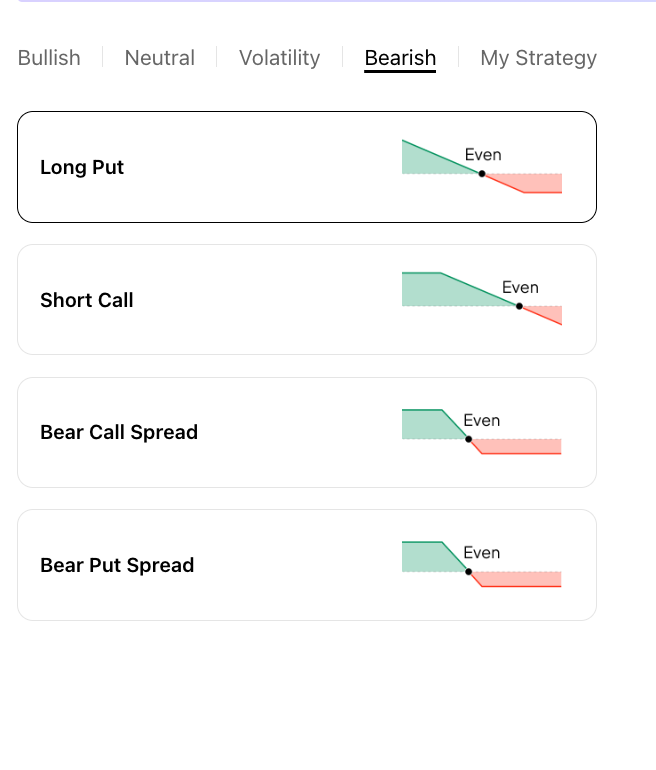
In the Strategy Builder, the Long Put diagram shows a green-shaded profit zone to the left of the breakeven point, with the profit line rising as the underlying price falls. To the right of the breakeven, the red-shaded loss zone is flat and capped at the premium paid. The shape is a mirror image of the Long Call.
Greeks Context
- Delta: Negative (approximately -0.50 for an at-the-money put). The position profits from downward price movement.
- Gamma: Positive. The magnitude of delta increases as the stock moves in your favor.
- Theta: Negative. Time decay erodes the option's value every day.
- Vega: Positive. Rising implied volatility increases the option's value, which can be an additional tailwind during market selloffs when volatility typically spikes.
2. Short Call
Definition
A Short Call involves selling a call option. You collect the premium upfront and take on the obligation to sell the underlying asset at the strike price if the option is assigned.
When to Use
Use a Short Call when you expect the stock to stay flat or decline. You profit by keeping the premium as the option expires worthless.
Risk and Reward
- Max Profit: Limited to the premium received.
- Max Loss: Unlimited. Because the stock can rise indefinitely, there is no cap on potential losses.
- Breakeven: Strike price plus the premium received.
P&L Diagram
The diagram shows a flat green profit zone below the breakeven point (capped at the premium received) and a red loss zone that extends upward without limit as the underlying price rises. The unlimited loss potential is clearly visible as the line drops steeply to the right.
Important Warning
The Short Call carries unlimited risk and is considered an advanced strategy. If the stock rises sharply, losses can far exceed the premium collected. Many brokers require a high options approval level and significant margin to execute this trade. Make sure you understand the risks before using this strategy.
3. Bear Call Spread
Definition
A Bear Call Spread involves selling a call at a lower strike price and buying a call at a higher strike price, both with the same expiration date. You collect a net credit when entering the trade.
When to Use
Use a Bear Call Spread when you are moderately bearish and want to collect premium income with defined risk. The long call at the higher strike acts as a protective cap on your potential loss, making this a safer alternative to a naked Short Call.
Risk and Reward
- Max Profit: The net premium received. You keep the full credit if the underlying stays below the lower strike at expiration.
- Max Loss: The difference between the two strike prices minus the net premium received.
- Breakeven: Lower strike price plus the net premium received.
P&L Diagram
The Strategy Builder shows a flat green profit zone below the lower strike, a declining line between the two strikes, and a flat red loss zone above the higher strike. Both profit and loss are capped, creating a clean, bounded risk profile.
4. Bear Put Spread
Definition
A Bear Put Spread involves buying a put at a higher strike price and selling a put at a lower strike price, both with the same expiration date. You pay a net debit to enter the trade.
When to Use
Use a Bear Put Spread when you are moderately bearish and want defined risk at a lower cost than buying a standalone Long Put. The premium received from the short put partially offsets the cost of the long put.
Risk and Reward
- Max Profit: The difference between the two strike prices minus the net premium paid. You realize the full profit if the underlying falls below the lower strike at expiration.
- Max Loss: The net premium paid.
- Breakeven: Higher strike price minus the net premium paid.
P&L Diagram
The diagram shows a flat green profit zone below the lower strike, a rising line (moving from right to left) between the two strikes, and a flat red loss zone above the higher strike. Like the Bear Call Spread, both sides are capped.
How the Strategy Builder Visualizes Bearish Strategies
Across all bearish strategies, the Strategy Builder applies the same visual conventions:
- Green shading indicates the price range where the strategy is profitable.
- Red shading indicates the price range where the strategy loses money.
- Breakeven is the point where the P&L curve crosses zero.
- The vertical dashed line marks the current underlying price so you can immediately see whether the stock is in the profit or loss zone relative to your chosen strategy.
Use the expiration selector to compare how the P&L profile shifts across different timeframes. Shorter expirations produce steeper curves and faster time decay, while longer expirations give the trade more room to develop.
Try it on Ainvest: Open the Strategy Builder to model bearish strategies with live data.